
Emergency departments are not losing capacity because of documentation alone. They are losing minutes across an entire chain of work: triage, chart review, orders, consultations, diagnostic follow-up, reassessment, admission, discharge and handoff. An AI scribe can return valuable time to clinicians, but a faster note does not automatically produce a faster or safer emergency department.
That distinction matters. When an admitted patient has nowhere to go, when a critical result is buried among routine notifications, or when the same information must be entered into several systems, the problem is not transcription. It is coordination. Solving the “ER hemorrhage” means stopping the steady loss of time, attention and clinical capacity at every transition—not simply generating notes more quickly.
The video below explores why healthcare organizations must look beyond the AI scribe. The next generation of clinical AI should support the full care journey while keeping clinicians in control: capture the encounter, organize the evidence, surface urgent work, coordinate the next action and verify that nothing important was left behind.
The scribe solves one visible burden
Documentation is an obvious target for automation because clinicians can see and feel the burden. A well-designed ambient scribe can listen to the clinical conversation, draft a structured note and reduce after-hours charting. That can improve attention during the encounter and give physicians more time for patients, families and clinical reasoning.
But the note is only one product of an emergency visit. The clinician must also interpret prior records, decide which tests are needed, monitor results, reassess the patient, coordinate with nurses and consultants, determine disposition, explain the plan and ensure follow-up. A polished note may describe these activities without advancing any of them.
The risk is mistaking documentation efficiency for system efficiency. If the physician saves several minutes on a note but then spends them hunting for a consultant response or refreshing the chart for an imaging result, capacity has merely moved. The organization has optimized one task while leaving the patient journey fragmented.
| Operational problem | What an AI scribe can do | What broader clinical AI must add |
|---|---|---|
| Encounter documentation | Draft the history, examination and assessment | Validate structure, highlight uncertainty and support coding without inventing facts |
| Information overload | Capture the current conversation | Synthesize relevant history, medications, results and recent changes |
| Pending work | Mention a test or consultation in the note | Track status, ownership, urgency and required follow-up |
| Patient flow | Document the disposition decision | Expose discharge barriers, admission delays and available next actions |
Emergency care is a network of dependencies
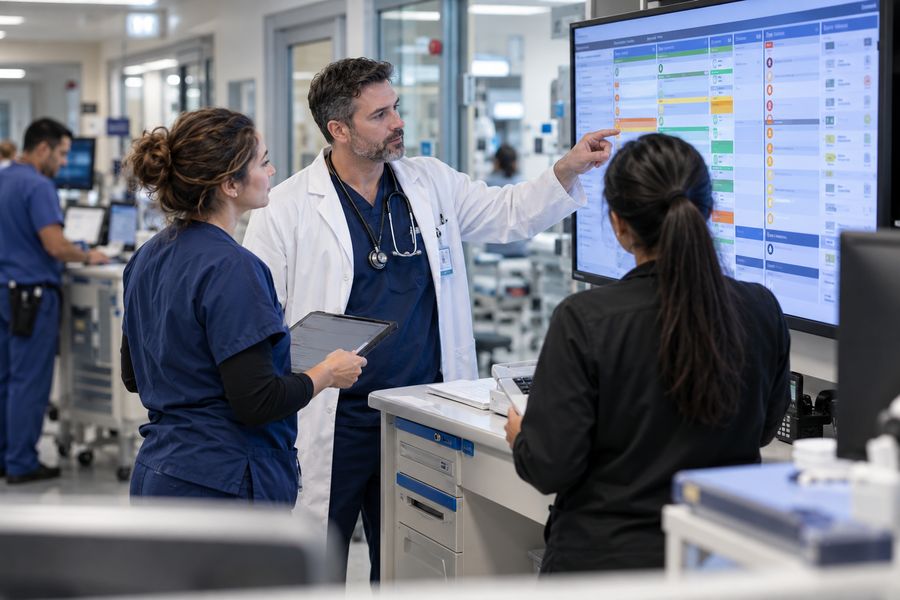
Every emergency visit depends on people and services beyond the treating physician. A nurse must administer medication, the laboratory must process specimens, radiology must acquire and interpret imaging, a consultant may need to evaluate the patient, and an inpatient unit or community service must accept the next phase of care.
Delays often occur between these steps. An order may be placed correctly but not collected. A result may be available but not acknowledged. A consultant may agree with admission but the bed request remains incomplete. A patient may be medically ready for discharge but still need transportation, medication access or understandable instructions.
Clinical AI can help by creating a shared operational picture. Instead of another dashboard full of data, it should show what is blocking the next safe action: which result is outstanding, who owns it, how long the patient has waited and whether escalation is appropriate. The system should direct attention, not merely add alerts.
Brief team huddles remain essential. AI can prepare the huddle by grouping patients according to risk and flow barriers, but people must resolve priorities. The charge nurse may know that staffing makes a theoretically available bed unusable. The physician may know that a stable-looking patient is at risk of rapid deterioration. Operational data becomes useful only when combined with frontline judgment.
This is why emergency department improvement is hospital-wide. Boarding occurs in the ED, but its causes often involve inpatient capacity, discharge timing, environmental services, transport and community placement. No documentation tool can create a bed or discharge an inpatient whose downstream care is unavailable.
Interruptions quietly consume clinical capacity
Emergency clinicians work in a constant stream of pages, questions, alerts, phone calls and changing priorities. Some interruptions are vital; a deteriorating patient should interrupt routine work. Others are poorly routed requests that arrive at the wrong time or through the wrong channel.
The cost is not only the interruption itself. The clinician must remember where the original task stopped, reconstruct context and decide whether anything was missed. That task-switching increases cognitive load and creates opportunities for wrong-patient orders, incomplete documentation and forgotten follow-up.
AI should not respond by silencing the department. It should help distinguish immediate clinical danger from work that can wait. Routine messages can be bundled for asynchronous review, while time-critical changes should escalate through a clearly approved pathway. The goal is fewer low-value disruptions without weakening the team’s willingness to speak up.
| Signal | Recommended handling | Human safeguard |
|---|---|---|
| Immediate threat Critical deterioration or life-threatening result | Interrupt immediately through the approved escalation channel | Receiver acknowledges and assumes ownership |
| Time-sensitive action Medication, reassessment or disposition milestone | Prioritized task with deadline and visible owner | Clinician verifies urgency and action |
| Routine update Expected result or non-urgent response | Bundle for review at an appropriate pause | Escalation remains available if context changes |
| Administrative request Non-clinical form or duplicate status question | Route to the correct role or automate where safe | Exception path for unusual cases |
Turn fragmented data into situational awareness

The emergency record contains more information than any clinician can read during a crowded shift. The useful question is not whether data exist, but whether the right information reaches the right person before a decision.
Broader clinical AI can summarize recent admissions, identify a meaningful medication change, display trends in laboratory values and connect a current symptom with a relevant prior investigation. It can also detect conflicts: a note that describes one plan while the active orders show another, or a discharge instruction that does not reflect the final medication list.
However, synthesis is not certainty. A model may omit context, misunderstand negation, prioritize an incidental detail or reproduce outdated information. Every summary should link back to its source so the clinician can verify it. High-impact recommendations require transparent reasoning, appropriate evidence and explicit human acceptance.
Good design also respects the stage of care. At triage, the priority is acuity and immediate risk. During evaluation, the clinician needs differential diagnosis, test status and response to treatment. At disposition, the focus shifts to stability, barriers, follow-up and the completeness of the handoff. Showing everything at every moment creates another form of overload.
Equity must be monitored as well. Models trained on historical utilization may learn patterns created by unequal access rather than true clinical need. Performance should be evaluated across patient groups, languages, ages and care settings, with a clear process for reporting unsafe or biased outputs.
The largest bottleneck may be outside the emergency department
When admitted patients remain in emergency beds, new arrivals have fewer treatment spaces. Waiting rooms grow, ambulance offload slows and clinicians care for both undifferentiated emergencies and boarded inpatients. The same staff must manage more patients across longer periods and different levels of care.
AI can make this constraint visible, forecast likely admissions, identify patients approaching discharge readiness and help coordinate transport or environmental services. But forecasting does not replace capacity. Leaders must act on the information by adjusting staffing, smoothing elective demand, improving inpatient discharge processes and creating escalation plans for predictable surges.
The correct unit of optimization is the hospital, not the emergency department alone. A local improvement that moves work downstream without adding capacity can worsen another team’s burden. Measures should therefore follow the complete journey from arrival through admission or safe discharge.
| Flow stage | Common friction | Useful AI support | Operational response |
|---|---|---|---|
| Arrival and triage | Variable demand and incomplete history | Risk-sensitive intake summary and demand forecasting | Flexible staffing and clinician validation |
| Diagnostics | Uncollected orders and delayed review | Status visibility and prioritized result notification | Defined escalation and ownership |
| Consultation | Repeated calls and unclear response time | Structured request and transparent queue | Service-level expectations and backup pathway |
| Admission | Boarding and uncertain bed readiness | Capacity forecast and barrier identification | Hospital-wide flow command and surge plan |
| Discharge | Instructions, medication or follow-up incomplete | Reconciled draft and readiness checklist | Teach-back and confirmed follow-up |
Discharge is a clinical handoff, not an exit event

A patient leaving the ED may still have pending cultures, final imaging interpretations, medication changes and follow-up needs. If no one owns those tasks, a fast discharge can create delayed risk and more work later.
Clinical AI can prepare plain-language instructions from the verified plan, reconcile the final medication list, translate approved content and identify missing follow-up details. It can also place pending results into a monitored queue instead of relying on memory or an individual inbox.
The clinician must review the final instructions and confirm that they match the patient’s condition. The patient or caregiver should understand warning signs, what to do next and how to obtain help. Teach-back is more meaningful than a signature confirming that a document was received.
Technology should adapt to practical barriers. A follow-up plan is not complete if the patient lacks transportation, cannot afford the medication, needs an interpreter or cannot access the recommended service. These barriers should become visible early enough for the team to address them.
Safe discharge demonstrates the larger principle: AI creates value when it connects documentation to action. The note records what happened; the workflow ensures that the next necessary step actually has an owner.
Measure capacity returned—not text produced
An AI program can appear successful because clinicians adopt it or because it generates thousands of notes. Those measures say little about emergency care. Hospitals should evaluate whether the technology reduces rework, improves response time, shortens avoidable delays and protects attention without creating new safety risks.
Documentation time still matters, but it belongs beside operational and clinical measures. Leaders should monitor alert burden, time from result to action, consultation turnaround, boarding hours, left-without-being-seen rates, discharge completeness, return visits and staff experience. Balancing measures are necessary so speed does not hide omissions or inequity.
| Measurement domain | Example indicator | Question it answers |
|---|---|---|
| Clinician time | Minutes of documentation and after-hours chart work | Did the tool return usable clinical time? |
| Attention | Interruptions, duplicate alerts and abandoned tasks | Did cognitive fragmentation decrease? |
| Flow | Time to result action, disposition and departure | Did patients move safely with less avoidable waiting? |
| Safety | Missed results, corrected AI output and near misses | Did automation reduce or introduce risk? |
| Equity | Performance and delays across demographic and language groups | Are benefits and errors distributed fairly? |
A practical roadmap beyond the AI scribe
Start by mapping one patient journey in detail. Observe where people wait, where information is re-entered, which alerts interrupt work and which tasks repeatedly lose ownership. Include physicians, nurses, registration, diagnostics, consultants, bed management and patients. The most expensive friction may be invisible from leadership dashboards.
Next, choose a narrow workflow with a measurable problem. A hospital might begin with pending-result follow-up, consultation coordination or discharge readiness. Define who retains authority, what the AI may recommend, when human review is mandatory and what happens when the system is unavailable.
Integrate the tool into existing work instead of creating another destination. Staff should not copy information between an AI interface and the electronic health record. Outputs should be source-linked, auditable and easy to correct. Privacy, security, retention and access controls must be designed before live clinical use.
Pilot under real conditions, including nights, weekends and crowding. Compare results with a baseline, review failures with frontline teams and expand only when the workflow demonstrates meaningful benefit. A tool that works during a quiet demonstration may fail when the department is interrupted, understaffed or operating above capacity.
Finally, keep humans accountable for clinical decisions and organizations accountable for operational constraints. AI can expose a bottleneck; leadership must remove it. It can draft a plan; a clinician must determine whether that plan is right for this patient.
The future of emergency AI is coordinated action
AI scribes are a valuable beginning. They address a genuine source of frustration and can make the patient conversation feel more human. But emergency departments will not recover sustainable capacity by producing notes faster while results, beds, consultations and transitions remain disconnected.
The larger opportunity is clinical orchestration: turning scattered information into a shared understanding of risk, ownership and next actions. Done well, AI can reduce low-value interruptions, make pending work visible, support earlier decisions and help every member of the care team operate from the same current plan.
Success should be visible in the department—not only in a technology report. Clinicians should spend less time reconstructing context. Patients should wait less for avoidable reasons. Critical work should be harder to lose. Discharge and admission should become coordinated transitions rather than administrative endpoints.
Stopping the ER hemorrhage requires more than a digital listener. It requires a clinically governed system that connects the conversation to the work, the work to an owner and the owner to a safe outcome. The scribe writes what happened. The next generation of clinical AI must help the team decide—and complete—what happens next.
Important: This article provides general educational information and is not medical, legal, procurement or operational advice. Clinical AI should be evaluated and governed according to the organization’s patient population, workflows, professional standards, privacy obligations, technology environment and applicable regulations.
Further reading
| Organization | Resource | Focus |
|---|---|---|
| Agency for Healthcare Research and Quality | AHRQ Summit to Address Emergency Department Boarding | Hospital-wide contributors and strategies for boarding and crowding |
| American College of Emergency Physicians | Emergency Department Boarding and Crowding | Evidence and operational resources addressing ED boarding |
| American Academy of Emergency Medicine | Interruptions in the Emergency Department | Task-switching, safety, wellness and interruption management |
| Agency for Healthcare Research and Quality | Understanding the AI Wave: Conclusion | Potential benefits, limitations and oversight of AI in diagnosis |