
The most dangerous healthcare AI is not always the system that obviously fails. Sometimes it is the system that works often enough, sounds confident enough and makes life easy enough that people stop checking it. When assistance becomes authority, convenience can quietly weaken the very clinical judgment the technology was meant to support.
Healthcare organizations understandably want AI to summarize records, draft notes, prioritize alerts, suggest diagnoses and recommend next steps. Used carefully, these tools can reduce cognitive overload and help clinicians find relevant information faster. But a tool can become “too helpful” when it removes productive friction—the pause that prompts a clinician to reconsider, verify a source or notice that this patient does not fit the pattern.
The video below introduces this overlooked risk. The question is not whether AI should help clinicians. It is how to design assistance that strengthens attention, judgment and accountability instead of encouraging passive acceptance.
Helpfulness becomes risk when verification disappears
Clinical work contains many repetitive and information-heavy tasks. AI can assemble a patient history, flag a possible interaction or generate a draft assessment in seconds. That speed is valuable, especially when teams are busy. Yet speed changes behaviour. If an output looks complete and professional, users may spend less time looking for what is missing.
This tendency is known as automation bias: people may favour a machine’s recommendation over other available evidence. It can produce a commission error, in which someone follows incorrect advice, or an omission error, in which no action is taken because the system failed to warn them.
The issue is not simply that clinicians “trust AI too much.” Trust is necessary for useful technology. The problem is poorly calibrated trust—relying on a system outside the conditions where it performs reliably, or treating a probabilistic output as a fact. A safe system helps users understand when confidence is justified and when independent review is essential.
| Helpful feature | Hidden risk | Safer design response |
|---|---|---|
| Automatic clinical summary | Omitted or outdated context appears complete | Link every important claim to its source and timestamp |
| Diagnostic suggestion | The first plausible answer anchors later reasoning | Show alternatives, uncertainty and evidence for disagreement |
| Automated alert | Too many low-value warnings train users to dismiss alerts | Prioritize by clinical urgency and continuously measure overrides |
| Preselected order or action | Default becomes a decision without active review | Require meaningful confirmation for high-impact actions |
Automation bias: when the suggestion becomes the answer

Imagine an AI system identifies pneumonia on a chest image and places that conclusion prominently at the top of the screen. Even if the clinician planned to review the image independently, the suggestion has already shaped attention. Features consistent with pneumonia may become easier to see; evidence supporting another diagnosis may receive less weight.
The reverse is equally important. If the system reports no abnormality, the user may look less carefully. A false negative is especially difficult because the absence of an alert feels like reassurance, even when the model never had enough information to make a reliable judgment.
Time pressure increases the attraction of a ready answer. So do fatigue, high workload and unfamiliar cases. Less-experienced clinicians may benefit greatly from support while also finding it harder to recognize when the recommendation is implausible. Experienced clinicians are not immune; repeated exposure to accurate outputs can create learned complacency.
The solution is not to hide useful recommendations. Systems should be designed to preserve independent thinking. In high-stakes workflows, clinicians might record an initial impression before revealing the AI result, or the interface might present supporting and conflicting evidence rather than a single directive.
Most importantly, disagreement must be easy. If overriding the AI requires extra clicks, extensive documentation or fear of later criticism, the workflow turns optional advice into practical authority. A clinician who departs from the model should be able to document a concise reason without being treated as the error.
Alert fatigue is over-helpfulness at scale
Clinical decision support often begins with a sensible goal: warn users about every potentially dangerous interaction, abnormal result or missing action. But a system that interrupts too often teaches people that interruption is normal. Clinicians begin to scan, dismiss and move on because most alerts do not change care.
This creates a paradox. Adding more warnings can make the environment less safe if important signals are buried among routine ones. The risk is not only the number of alerts but their timing, relevance and actionability. A warning that arrives after the decision, lacks patient-specific context or offers no clear next step consumes attention without supporting care.
Generative AI may worsen the problem by making it inexpensive to create more explanations, reminders and suggestions. Helpful prose still requires time to read. Systems need an attention budget: only interrupt when the expected clinical value justifies taking a clinician away from the current task.
| Priority | Presentation | Required response | Example |
|---|---|---|---|
| Critical | Immediate interruptive alert | Acknowledge, act or explicitly redirect ownership | Rapid deterioration requiring urgent assessment |
| Time-sensitive | Prominent task with deadline | Review within the defined window | Result needing action before discharge |
| Advisory | Non-interruptive contextual guidance | Review when making the relevant decision | Alternative medication based on current renal function |
| Informational | Available on request or in a digest | None unless clinically relevant | Background guideline or educational reference |
More information can produce less awareness

AI systems can generate detailed summaries, risk scores, recommended questions, differential diagnoses and care plans. Each element may be individually useful. Combined, they can crowd the interface and compete with the patient’s immediate story.
Situational awareness depends on knowing what matters now. A triage nurse, hospitalist, radiologist and pharmacist need different information at different moments. A system that shows the same comprehensive output to everyone is not personalized decision support; it is another record to navigate.
Good clinical AI uses progressive disclosure. The first view should communicate the urgent signal, its relevance and the action required. Supporting evidence, limitations and source details should remain one step away. This allows rapid orientation without sacrificing verification.
Concision also creates risk if it hides uncertainty. A short statement such as “low risk” can appear definitive even when the model encountered missing data or a population unlike its training set. The interface should distinguish “low predicted risk based on complete data” from “unable to assess reliably.” Those are not equivalent messages.
The best interface is therefore not the one that displays the most intelligence. It is the one that helps the user form an accurate mental model: what the system knows, what it does not know, why this output appeared and what requires human judgment.
Skill erosion is a long-term patient-safety risk
When a task is routinely automated, people get fewer opportunities to practise it. Navigation apps changed how many people remember routes; autocomplete changed how they compose text. In healthcare, the stakes are higher. If clinicians rarely construct a differential diagnosis, interpret a basic pattern or reconcile a medication list without assistance, their ability to detect automation failure may weaken.
This does not mean healthcare should preserve inefficient manual work for tradition’s sake. It means organizations must identify which competencies remain essential when automation is unavailable, wrong or outside its intended use. Training should include cases where the AI is confidently incorrect, incomplete or silent.
Downtime procedures are not enough if staff have never practised them. Teams need periodic simulation, independent review samples and clear escalation pathways. New clinicians should learn the underlying reasoning before becoming dependent on shortcuts. Senior clinicians should remain engaged enough to recognize subtle drift in practice.
| Capability | Risk of over-automation | How to preserve resilience |
|---|---|---|
| Diagnostic reasoning | AI suggestion anchors the differential | Independent assessment exercises and disagreement review |
| Image or signal interpretation | Users inspect only highlighted regions | Periodic unassisted reads and blinded quality sampling |
| Medication reconciliation | Copied lists preserve outdated or duplicate therapy | Patient confirmation and source comparison for high-risk drugs |
| Clinical documentation | Polished language hides unsupported details | Source-linked drafts and targeted note audits |
“Human in the loop” is not a safety guarantee
Many AI programs claim safety because a clinician approves the final output. That label can be misleading. A human cannot provide meaningful oversight if the system generates dozens of recommendations, hides its evidence, pressures rapid approval or makes correction harder than acceptance.
Effective oversight requires time, authority and information. The reviewer needs to know the intended use, relevant limitations, data sources and confidence boundaries. They must be able to change or reject the output, and the organization must support that decision.
Responsibility must also be specific. “The clinician is responsible” does not explain who monitors model performance, investigates errors, updates workflows or pauses the tool when patient harm is possible. Vendors, clinical leaders, informatics teams, privacy officers and quality departments each own different controls.
Design the human–AI team, not the model alone
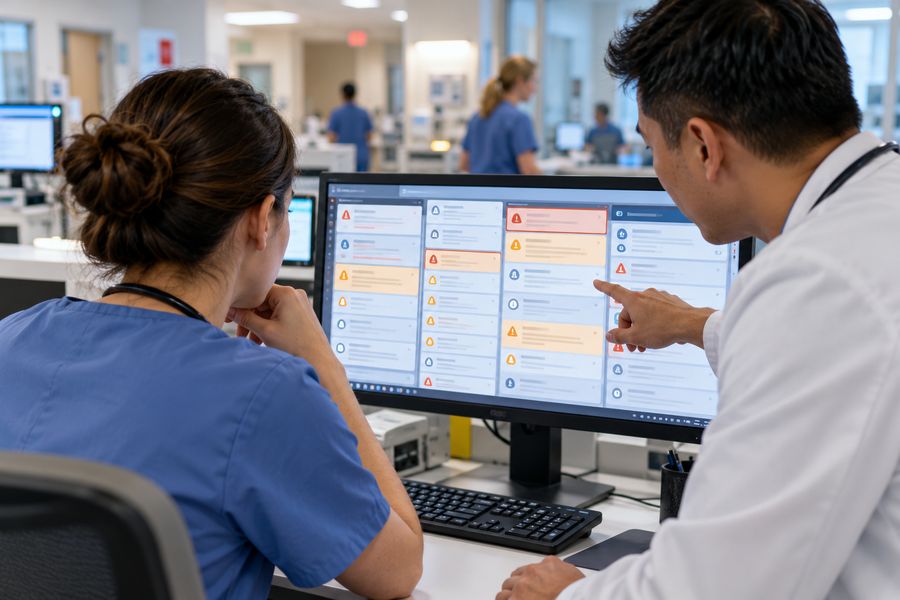
A model can perform well in a controlled evaluation and still fail in practice. The interface may encourage anchoring, an alert may arrive too late, or staff may assume another person reviewed the recommendation. Safety depends on the combined performance of the technology, user and workflow.
Start by defining the AI’s role. Is it drafting, screening, prioritizing, recommending or acting? The greater the clinical consequence and autonomy, the stronger the evidence, confirmation and monitoring requirements should be. An AI-generated appointment reminder does not require the same control as an automated medication adjustment.
Next, define the moment of human judgment. Review should occur before the output causes a high-impact action, not after it is copied into the record or sent to the patient. The interface should make uncertainty visible and provide direct access to source evidence.
Disagreement should become learning data. When clinicians frequently override a recommendation, the organization should investigate whether the model is wrong, the workflow lacks context or users need training. Overrides are not automatically evidence of resistance.
Finally, include patients where appropriate. They should know when AI materially influences their care, especially in patient-facing communication or high-impact decisions. Human explanation and accountability must remain available; a model output should never become a barrier to asking questions.
Monitor what happens after launch
Validation before deployment is essential but insufficient. Clinical practice changes, patient populations shift, documentation patterns evolve and software integrations are updated. These changes can cause model drift or alter how users interpret the output.
Monitoring should combine technical, clinical and human-factors measures. Accuracy and calibration matter, but so do override rates, response times, alert burden, workflow workarounds and differences across patient groups. Near misses and user complaints can reveal failures that aggregate performance metrics hide.
Organizations also need predefined thresholds for intervention. Who can restrict or pause the system? What level of unexpected harm, subgroup disparity or performance degradation triggers review? Without these decisions in advance, teams may continue using a questionable tool while responsibility is debated.
| Monitoring domain | Example measure | Warning sign |
|---|---|---|
| Performance | Sensitivity, specificity and calibration in current use | Decline from the approved baseline |
| Human behaviour | Acceptance, override and verification rates | Near-universal acceptance without documented review |
| Attention | Alerts per user and response time by priority | Critical alerts handled like routine messages |
| Equity | Error and benefit rates across meaningful subgroups | Persistent disparity hidden by overall averages |
| Resilience | Downtime performance and staff competency | Care slows or becomes unsafe when AI is unavailable |
A practical checklist for responsible helpfulness
Before deployment, define the exact problem and confirm that AI is the appropriate intervention. Document the intended users, patient population, exclusions, known limitations and consequences of false-positive and false-negative outputs. Test the complete human–AI workflow under realistic pressure, not only the model in isolation.
During implementation, train users to verify outputs and recognize failure modes. Make sources, timestamps and uncertainty accessible. Avoid defaults that silently trigger high-impact actions. Ensure clinicians can disagree without excessive friction and provide a clear route for reporting unsafe behaviour.
After launch, audit outputs and outcomes continuously. Review overrides, near misses and unexpected patterns across patient groups. Practise downtime and unassisted workflows. Retire alerts that do not change care, and pause features when evidence no longer supports safe use.
Most importantly, measure whether the system improves the human–AI team. A higher standalone model score does not guarantee safer care if people become less attentive, less skilled or unable to challenge it. Success means better decisions, stronger situational awareness and clear accountability—not simply more automation.
The safest AI leaves room for judgment
Healthcare AI should be helpful. It should reduce clerical burden, organize fragmented evidence and bring important risks to attention. But it should not make uncertainty disappear, convert suggestions into silent defaults or create the impression that no alert means no danger.
The overlooked risk is not only a bad model. It is a good model placed in a workflow that rewards passive acceptance. A system can be accurate most of the time and still make the overall team less safe if users lose vigilance or cannot recognize its rare failures.
Responsible clinical AI preserves meaningful human control. It shows its evidence, communicates limits, invites disagreement and monitors real-world performance. It automates the work that machines can do reliably while protecting the observation, empathy and contextual reasoning that clinicians uniquely contribute.
When AI becomes “too helpful,” the answer is not to reject it. The answer is to redesign the relationship. The best technology does not ask clinicians to trust more. It helps them know when to trust, when to verify and when to take back full control.
Important: This article provides general educational information and is not medical, legal, regulatory, procurement or operational advice. Healthcare AI should be evaluated and governed according to its intended use, patient population, professional standards, applicable regulations and the organization’s clinical, privacy and security requirements.
Further reading
| Organization | Resource | Focus |
|---|---|---|
| World Health Organization | Ethics and Governance of Artificial Intelligence for Health | Human autonomy, safety, transparency, accountability and equity |
| Agency for Healthcare Research and Quality | Clinical Decision Support | Decision support benefits, alert overload and clinical implementation |
| Agency for Healthcare Research and Quality | Understanding the AI Wave: Conclusion | Diagnostic opportunity, bias, opacity, hallucinations and oversight |